Research
60714
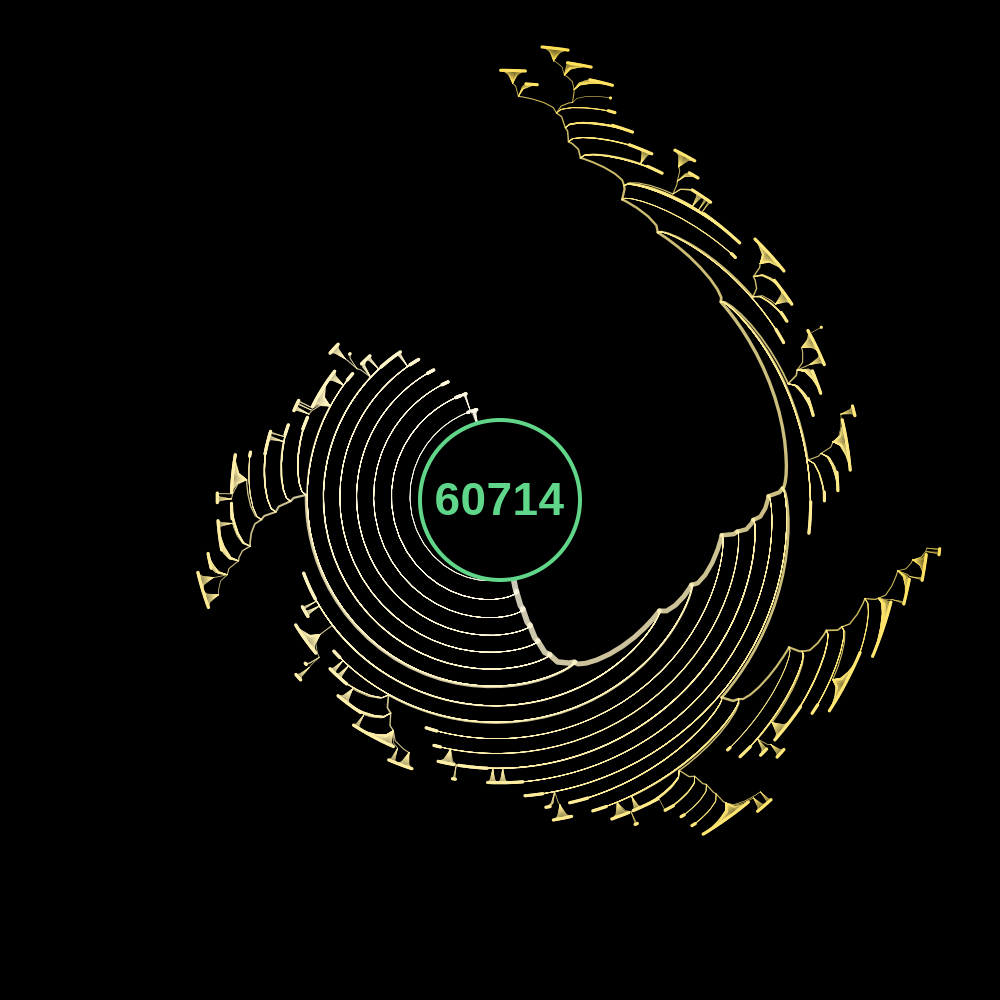
Kaprekar's routine sends every four-digit number to 6174. With the subtraction reordered, every five-digit number that is not one repeated digit lands on 60714.
If the video does not play here, watch it on YouTube.
The rule
- Sort the five digits from biggest to smallest and call them A, B, C, D, E.
- Write two numbers from those letters, ADCBE and DEACB, and subtract.
- Take the positive difference and keep five digits. Leading zeros count, so 714 is written 00714.
- Repeat with the new number.
An example: 58196 → 43713 → 41607 → 60714.
- 58196 sorts to 98651, and 95681 − 51968 = 43713.
- 43713 sorts to 74331, and 73341 − 31734 = 41607.
- 41607 sorts to 76410, and 71460 − 10746 = 60714.
- 60714 sorts to 76410 again, so from here it stays at 60714.
What is true
- Computed All 99,990 five-digit strings that are not a single repeated digit reach 60714, in at most 30 steps. The ten repeats (00000, 11111, ...) go to 0.
- Computed Counting only rules where every digit takes part, there are 33 numbers at five digits that are the single endpoint of some rule. 60714 is the only one that is still the endpoint at six digits. Its digits are those of Kaprekar's 6174 plus a zero.
- Computed Without the sorting step, none of the 7,140 five-digit rules sends every start to one number.
- Computed At seven digits and up, with the rule extended to the longer length, 60714 is still reached by most starts, but a growing share collapses to 0 (about 12% of digit collections at 24 digits).
- Open The general problem: choose an endpoint, get a rule with a proof. No human mathematician has refereed any of this.
- Credit The four-digit result is D. R. Kaprekar's (1949). The family of rules that subtract one arrangement of the sorted digits from another was defined by K. Peterson and H. Pulapaka (2008).
A companion: 146070
From seven digits up, the 60714 rules lose a growing share of starts to 0. A second number, built from the same digits with one more zero, does not have that problem.
- Sort the six digits from biggest to smallest and call them A, B, C, D, E, F.
- Write two numbers from those letters, BFADCE and CBDEAF, and subtract.
- Take the positive difference and keep six digits. Repeat with the new number.
An example: 124598 → 235161 → 164070 → 146070.
- 124598 sorts to 985421, and 819452 − 584291 = 235161.
- 235161 sorts to 653211, and 516231 − 352161 = 164070.
- 164070 sorts to 764100, and 607140 − 461070 = 146070.
- 146070 sorts to 764100 again, so from here it stays at 146070.
- Computed At every length from 6 to 30 digits, with the rule extended to that length, every start that is not a single repeated digit reaches 146070. None collapses to 0 and none falls into a loop. The longest trip is 42 steps.
- Computed Every digit takes part in the rule at every length.
- Computed It is not the only number of this kind. A November 2026 search of all six-letter rules extended the same way found 551 that send every start to one number at every length checked (up to 20 digits), 75 of them starting at six digits. 146070 is the only one with exactly four nonzero digits that are all different: 7, 6, 4, 1, the digits of 6174.
- Not refereed An argument that this holds at every length from six digits up is written out with the source code. It relies on a computer check of a fixed, finite set of cases, and it has been reviewed by AI only, most recently with independently written code that reproduced its counts.
The tree and the step chart below can show all six-digit starts for 146070, and the calculator can follow it at any length from 6 to 20 digits.
How many steps does it take?
For each number of steps from 0 to 30, how many of the 99,990 five-digit starts reach 60714 in exactly that many. Only 60714 itself takes 0.
Show the counts as a table
How this was made
The questions and the direction are ours. The computation, the checking, and the drafting were done with AI models, Anthropic's Claude and OpenAI's ChatGPT, used as research tools.